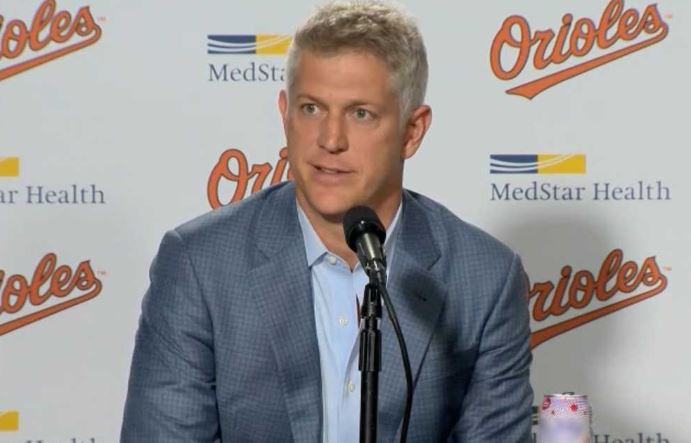
The Baltimore Orioles are preparing for what could be one of the most significant and defining offseasons in recent franchise history. Mike Elias, the organization’s president of baseball operations, has indicated that the front office is seriously considering a bold, forward-looking approach to addressing the team’s most glaring weakness: the starting rotation. Although the 2025 campaign ended with disappointment and frustration, falling short of both internal expectations and fan hopes, the Orioles are positioning themselves to use this setback as a turning point. Elias’ comments have made it clear that the club is ready to pursue aggressive and potentially franchise-shaping moves to strengthen the pitching staff for the long haul.
Bright Spots Amidst Struggles
While the season as a whole will be remembered as a letdown, it was not without its positives. The biggest revelation came in the form of Trevor Rogers, who emerged as the ace Baltimore had been searching for. Rogers’ year began with uncertainty after he suffered a partial kneecap dislocation that sidelined him for several months. Many wondered if he would be able to regain his form, but once he returned to the mound in June, he erased all doubts. Over 18 starts, Rogers not only proved he could handle the pressure of being a frontline starter but also delivered numbers that placed him among the very best pitchers in the league. His 1.81 ERA was the second-lowest of any pitcher who logged at least 100 innings, demonstrating remarkable consistency and dominance.
The impact of Rogers on the Orioles was immediate and measurable. Whenever he took the mound, the team seemed transformed. Baltimore finished with a strong 13-5 record in his starts, showing a level of competitiveness that was absent the rest of the time. By comparison, the Orioles’ overall season ended with a disappointing 75-87 mark, underscoring just how much of a difference an ace-caliber pitcher can make to a club’s fortunes. For Elias and the rest of the front office, Rogers’ breakthrough offered a glimpse of the kind of rotation anchor they need to build around if they want to compete consistently at the highest level.

A New Direction for Pitching Investments
As the offseason approaches, one reality looms larger than any other for Baltimore: the need to surround Rogers with a legitimate, competitive rotation. For years, Elias has built his reputation as a cautious decision-maker when it comes to free agency. His strategy has traditionally leaned toward avoiding the pitfalls of long-term deals, instead favoring one-year contracts with veteran pitchers who could provide short-term depth without tying up future payroll.
That philosophy was evident last winter, when Elias publicly acknowledged that the team was considering multiple approaches to strengthening its staff. Despite discussing the possibility of targeting high-end free agents, the Orioles ultimately signed veterans such as Charlie Morton and Tomoyuki Sugano on short-term agreements. While these additions provided stability, they lacked the long-term upside that fans and analysts were hoping for. Meanwhile, other teams were more aggressive. Notably, the Arizona Diamondbacks swooped in to secure Corbin Burnes, a move that left the Orioles empty-handed in the chase for elite pitching talent.
This approach has kept Baltimore’s financial flexibility intact but has also created frustration among the fan base, who see a roster with promise yet limited by the absence of durable, top-tier arms. With Rogers’ rise to prominence, however, the calculus is shifting. The Orioles no longer just need stopgap options—they need long-term solutions that will allow them to contend consistently.

Commitment to Long-Term Solutions
Recent statements from Elias strongly suggest that he is ready to break from past habits and consider making the kinds of big, long-term investments that the organization has previously shied away from. Appearing on the MLB Trade Rumors Podcast, Elias was candid about the direction the team may take. “We don’t want to take that off the table,” he said when asked about the possibility of pursuing multi-year deals with premier pitchers. He acknowledged the inherent risks that come with committing to arms that could be vulnerable to injuries but emphasized that this is simply the reality of competing at the highest level. “The best arms are always going to command long deals, and that’s the price of poker,” Elias concluded, signaling a willingness to play in a high-stakes market.
This shift in tone represents a significant turning point for Baltimore. If the Orioles follow through, it would mean transitioning from a philosophy of cautious, short-term roster management to one that embraces the risks of major, long-term commitments in pursuit of greater rewards. For a team looking to re-establish itself as a perennial contender, such a change could prove decisive.

The Road Ahead
With Rogers anchoring the rotation and Elias signaling an openness to pursuing marquee pitchers in free agency, the Orioles have an opportunity to reshape their pitching identity this winter. The front office understands that acquiring another frontline starter—or even two—could dramatically alter the team’s trajectory. Beyond immediate competitiveness, these moves would send a strong message throughout baseball that Baltimore is serious about re-entering the conversation as a long-term powerhouse.
The Orioles’ offseason will therefore be watched closely, both by their fans and by the wider baseball world. Every indication suggests they are preparing to act more boldly than in years past, and the pursuit of elite pitching could define not just the next season but the next era of Orioles baseball. Whether they succeed in securing the ace-level talent they seek remains to be seen, but one thing is clear: the time for incremental steps has passed, and the franchise is ready to make a statement.