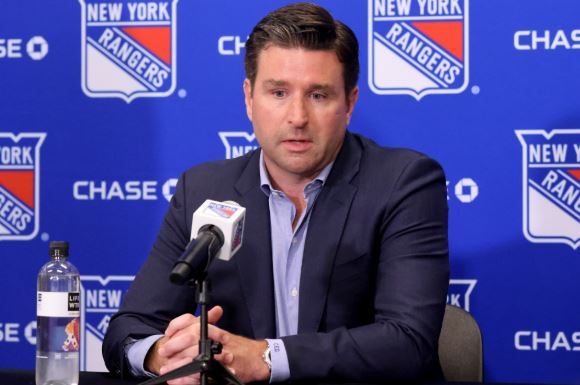
After the New York Rangers’ perplexing 2024-25 season, the league expected the Blueshirts to turn things around with new bench boss Mike Sullivan and improvements from players who had some of their worst years at the time. However, ten games into the new season, the Rangers are the weakest club in the Metropolitan Division, and it appears that the trend will continue. Even the Rangers’ better defensive numbers from their first eight games have swiftly dissipated, as the team has returned to surrendering multiple high-danger opportunities against Igor Shesterkin, similar of how the squad failed him last year.
And then the Rangers fell to two of the league’s weakest teams in a row. Here are few reasons why Chris Drury has not been a good President and General Manager.
Regrettable past decisions
The Pavel Buchnevich trade
Chris Drury took over as Rangers general manager almost immediately after Jeff Gorton and John Davidson were fired in May 2021, and just two months into the job, he dealt Pavel Buchnevich to the St. Louis Blues for Sammy Blais and a 2022 second-round pick. At the time, Buchnevich had been the team’s fourth-leading scorer and arguably their second-most reliable forward. So when Drury moved him for what many viewed as a low return, it sparked immediate backlash among fans — and understandably so. Trading away a 26-year-old, cost-controlled winger raised serious concerns about the team’s direction.
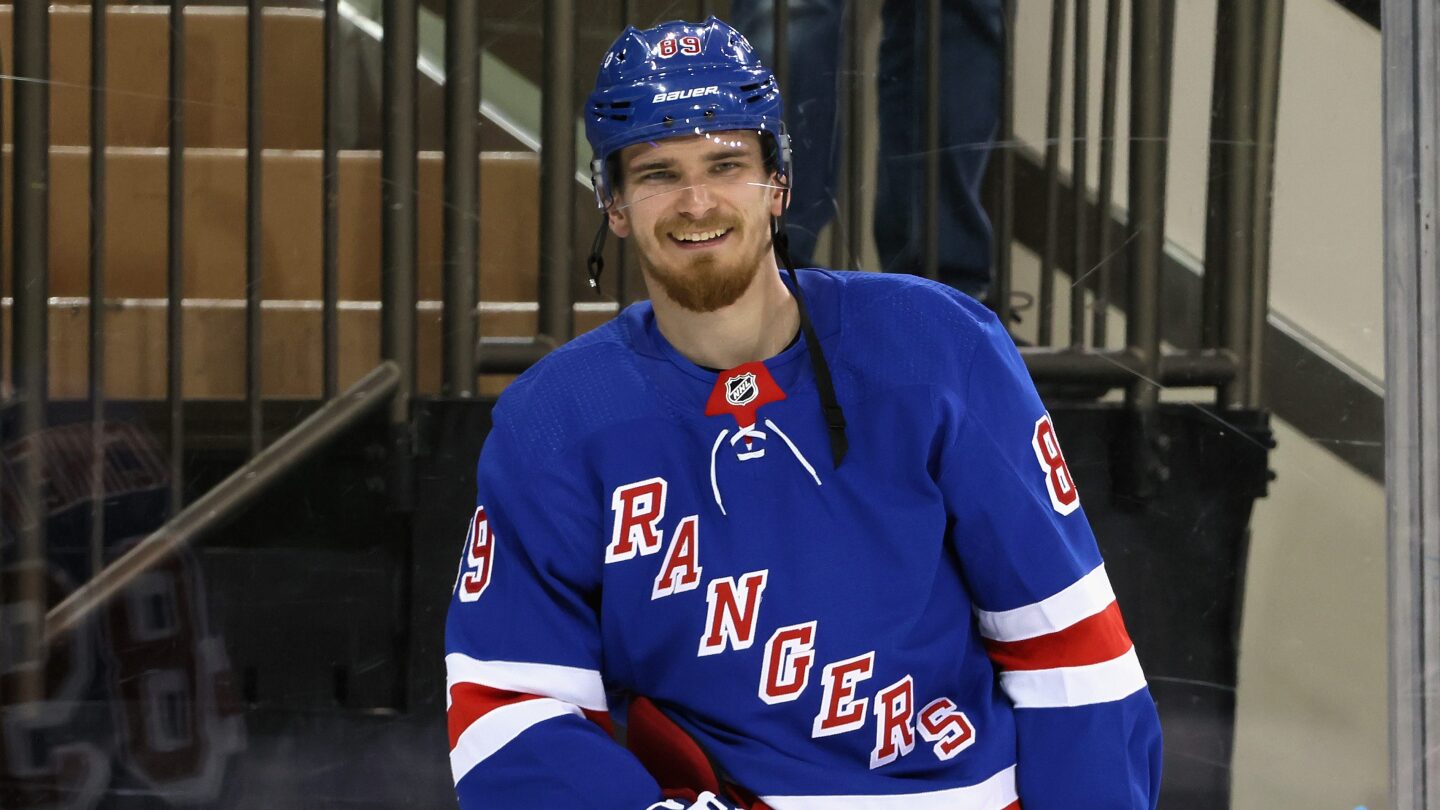
In reality, Drury’s decision stemmed from two main factors: he was eyeing a potential trade for Jack Eichel and wanted to preserve cap space, and he believed the team’s young wingers — Alexis Lafrenière, Kaapo Kakko, Vitali Kravtsov, and newly drafted Brennan Othmann — were ready to step into bigger roles. On paper, the idea of clearing room for that group made sense, but in practice, it backfired badly. Coaching decisions like playing Barclay Goodrow in the top six while Lafrenière and Kakko were stuck on the third line only made things worse. Beyond that, moving an already established young winger in anticipation of acquiring Eichel reflected poor asset management at its core. Now, in 2025, it’s hard not to look back and realize just how valuable a player like Buchnevich would be for the Rangers today.
Not trading for J.T. Miller earlier
During the 2022 trade deadline, The Athletic’s Arthur Staple reported that the New York Rangers were “very interested” in acquiring then–28-year-old J.T. Miller from Vancouver. Chris Drury’s plan was to leverage the team’s surplus of draft picks—rather than its top prospects—to secure win-now players. However, Canucks president Jim Rutherford held firm on his asking price, reportedly demanding Braden Schneider in any deal. With negotiations going nowhere, Drury pivoted to other targets like Andrew Copp.
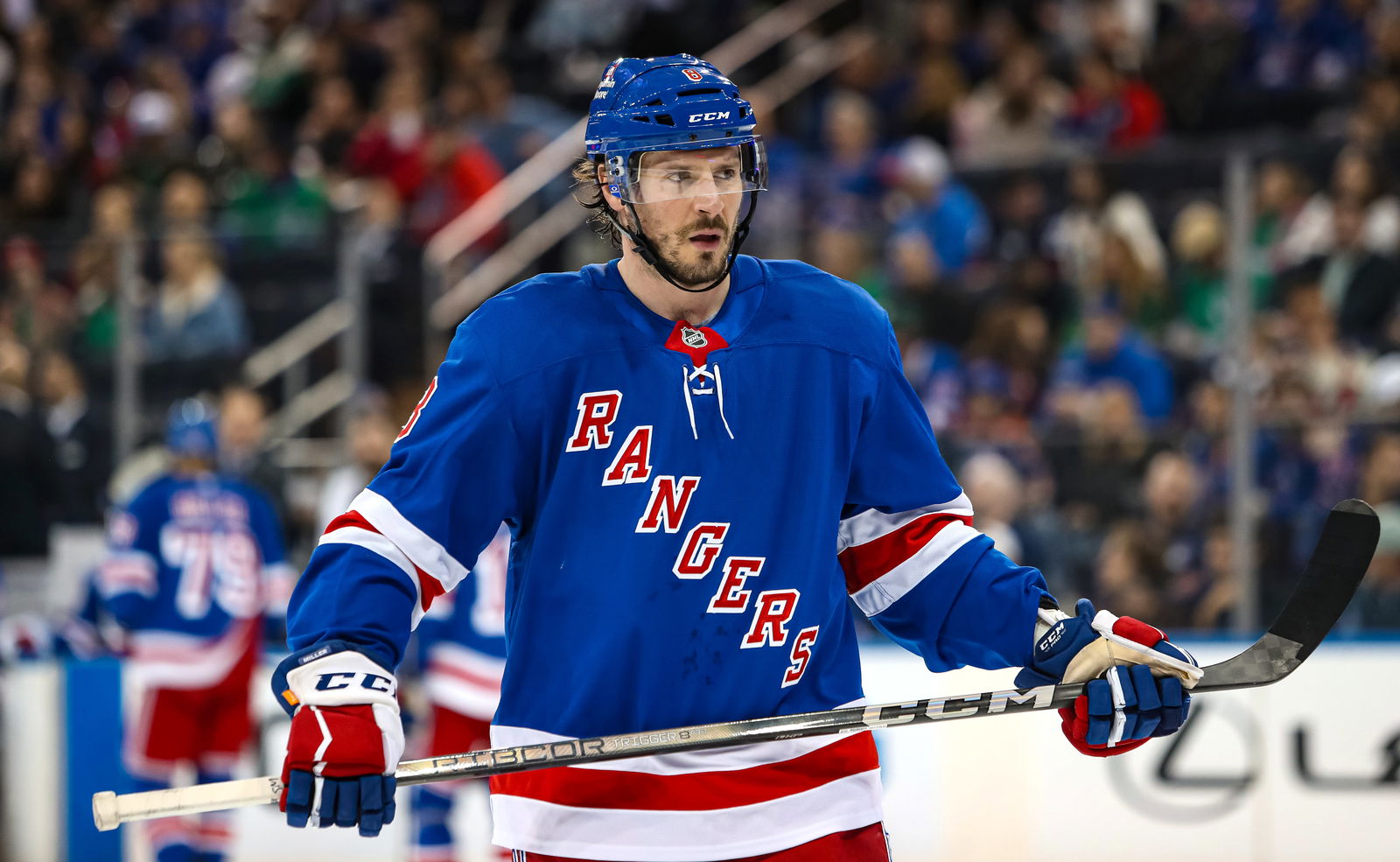
The logic of not moving a top prospect for a “rental” is understandable, but given that the Rangers were in clear win-now mode, a Stanley Cup run arguably should’ve taken precedence—especially since Schneider wasn’t an untouchable like Alexis Lafrenière. Fast forward to now: the Rangers have both Schneider and Miller, yet the 32-year-old captain has underperformed in his first full season back with New York. Miller’s 55% expected goal share is solid, but his six points in ten games and stretches of invisibility raise questions. Is he already declining? And did Drury acquire him too late in the team’s championship window?
Not trading for Jake Guentzel in 2024

At the 2024 trade deadline, Drury sought a winger to play alongside Chris Kreider and Mika Zibanejad, and the biggest name on the market was Jake Guentzel—an elite scorer who consistently elevates his play in the postseason. Pittsburgh’s asking price included Brennan Othmann, Kaapo Kakko, and a first-round pick. Drury refused to move Othmann or Kakko, and as a result, Guentzel was dealt to the divisional rival Carolina Hurricanes. Ironically, the Rangers later eliminated Carolina in a memorable Game 6, but they themselves fell to the eventual Stanley Cup champion Florida Panthers in the next round.
Drury correctly identified that the roster needed reshaping that offseason. He started by offloading Barclay Goodrow through a waivers loophole and sought a marquee free agent at the right price. Again, his eyes were on Guentzel, but Tampa Bay swooped in, acquiring and extending the winger. Eventually, Kakko was traded for Will Borgen, who’s been serviceable, while Othmann’s stalled development has made him a potential trade chip.
Ignoring the development of young talent
After drafting Lafrenière first overall in 2020, it appeared the Rangers were set for years of contention. The organization boasted a deep pool of young talent—Adam Fox, Igor Shesterkin, K’Andre Miller, Vitali Kravtsov, Filip Chytil, Kaapo Kakko, Braden Schneider, Ryan Lindgren, and Lafrenière himself. But in 2025, only Shesterkin, Fox, Schneider, and Lafrenière remain.

It seems Drury failed to learn from the Lias Andersson debacle that plagued the Jeff Gorton era. He retained the same development staff—Jed Ortmeyer and Tanner Glass—while keeping skills coach Mark Ciaccio on board. Nearly every Rangers first-round pick since 2017 (aside from Chytil) has failed to reach expectations. As a result, the team’s future now looks as uncertain as it did before the 2017 “letter,” with little evidence of progress in developing top-end prospects.

Will it get better anytime soon?
The Rangers’ current roster carries an average age of 28.08, skewed lower by a youthful bottom six rather than the aging core. Miller and Zibanejad are 32, Artemi Panarin is a pending UFA at 33 (turning 34 on October 30), and Vincent Trocheck is 32. Lafrenière, at 24, has seen his growth stagnate. Among top prospects, only Gabe Perreault projects as a possible top-six contributor—and even that’s uncertain given New York’s developmental track record. Optimism in Rangers land is dwindling, with limited young talent and an aging core.
Despite the frustrations, not every Drury move has been a misfire. The Vincent Trocheck signing, Adam Fox extension, and trades involving K’Andre Miller and Nils Lundkvist yielded solid returns. But for every success, there are puzzling decisions—like giving up a third-round pick for Carson Soucy or going all-in on Vladimir Tarasenko and Patrick Kane in 2023, only to lose both in free agency after a first-round exit to the Devils.
Now in his fifth full season as President and General Manager, Drury’s lack of a clear direction has become glaring. The Rangers need a new, modern voice at the helm—before their window closes completely.
