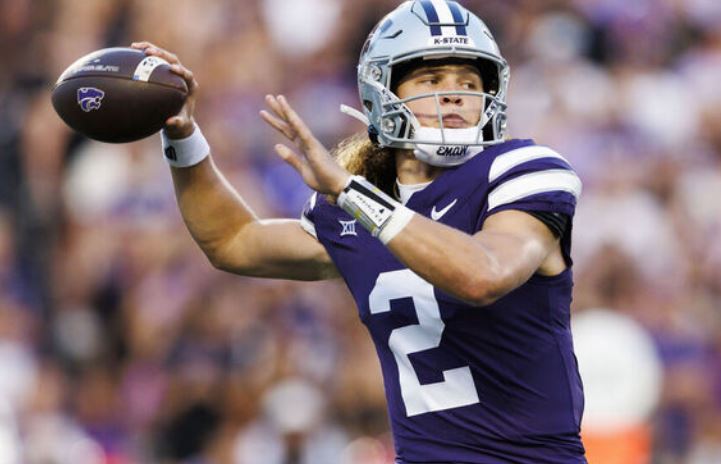
There’s a growing mix of optimism and concern surrounding the fact that Kansas State quarterback Avery Johnson is entering his final season of eligibility in 2026. The clock is ticking, and with it comes an urgent push to identify his eventual successor.

Kansas State’s 2027 quarterback situation could define the program
Unlike many programs in the Big 12, Kansas State chose not to sign a quarterback in the 2026 recruiting class. That decision appears intentional, with Johnson firmly locked in as the starter and the current depth chart filled out by Blake Barnett, Jacob Knuth, and Dillon Duff.
Looking ahead, the situation changes quickly. Once Johnson departs, Knuth also exhausts his eligibility, leaving Barnett, Duff, and recent commit Cam Kruse as the primary options in the quarterback room.
Johnson’s importance over the past several seasons cannot be overstated. Since Will Howard left the program in 2023, Johnson has been one of the most impactful players in Kansas State football, serving as the centerpiece of the offense and a driving force behind the team’s success.
Cam Kruse brings a familiar profile to Kansas State
Kruse is an in-state prospect with strong ties to Kansas, originally from Olathe. He spent part of his high school career in Tennessee after his father accepted a coaching position at Tennessee State, giving him experience in multiple football environments.

During the 2024–25 season, Kruse completed 88 passes for 1,164 yards and 13 touchdowns, including a long completion of 69 yards. The season before, he posted 1,173 passing yards and 11 touchdowns, though his efficiency numbers suggest he is still developing as a passer.
Compared to Johnson’s standout senior season in Kansas high school football, Kruse still has clear ground to cover if he hopes to compete for a starting role early in his college career. The biggest question isn’t physical ability, but experience and readiness.
Why Kruse’s development is so important
In the short term, Kruse is likely to serve as a developmental piece and depth option as he adjusts to the college level. If he shows progress in spring practice or earns opportunities in nonconference games, he could begin to carve out a role.
Long term, if he develops into a consistent starter by his second year and remains in the program, he has the potential to become the next key leader of Kansas State’s offense. With coaching support in place, his growth trajectory will be critical.
Ultimately, Kruse represents more than just another quarterback on the roster—his development could play a major role in shaping the future of Kansas State football in the post-Johnson era.