Six straight victories have completely changed the outlook for the Philadelphia Phillies, who have climbed back into a National League East race that appeared all but decided just a couple of weeks ago.
Heading into Wednesday’s series finale against the Arizona Diamondbacks, Philadelphia owns a 79–60 record and trails the Atlanta Braves (82–57) by only three games with 23 contests remaining. The Phillies are also sitting comfortably in the NL’s top Wild Card spot, meaning their biggest priority has shifted from simply making the postseason to chasing down Atlanta for the division crown.
The talent is there for Philadelphia to make a run. The Phillies have elite starting pitching, a powerful lineup, and several proven stars capable of carrying them through September. However, one major weakness continues to separate them from the Braves: defense.
The Phillies’ inability to consistently turn batted balls into outs has created a significant run-prevention gap and remains the biggest threat to their hopes of winning the division.

Phillies’ stars fueling a late-season surge
Philadelphia has been one of baseball’s hottest teams since the calendar flipped to August. The Phillies finished the month with a 21–7 record and have now won 15 of their last 17 games.
Bryce Harper has been at the center of the surge, reaching base safely in 34 consecutive games while hitting .345 with a 1.082 OPS during that stretch. His season OPS has climbed to .901, reminding the league why he remains one of the most dangerous hitters in baseball.
Kyle Schwarber continues to provide massive power, leading the team with 40 home runs and 83 RBIs. Luis Arraez has added another elite contact hitter to the lineup, while Trea Turner, Alec Bohm, and Bryson Stott have given Philadelphia enough depth to prevent opponents from simply pitching around its biggest stars.
The rotation has also been a major reason behind the turnaround.
Cristopher Sanchez has emerged as one of the league’s best pitchers, improving to 16–4 with a 2.52 ERA. Jesus Luzardo earned his 13th win Tuesday and leads the Phillies with 209 strikeouts. Since August began, Philadelphia’s pitching staff has posted a 2.65 ERA, while the bullpen owns MLB’s best mark during that span with a 1.93 ERA.
Those numbers explain why the Phillies have surged back into contention. They also make it easier to overlook a defensive issue that has followed the team all season.
Philadelphia has scored 631 runs, just 13 fewer than Atlanta. But the Phillies have surrendered 594 runs, 59 more than the Braves. That difference has left them with only a plus-37 run differential compared to Atlanta’s plus-109 mark.
Defense remains Philadelphia’s biggest weakness
According to Defensive Runs Saved, the Phillies rank last in Major League Baseball. While the lineup changes following the Arraez acquisition have provided some improvement, the damage from earlier in the season remains significant.
Second base and shortstop have each cost Philadelphia double-digit runs defensively, while left field has also graded below average.
The biggest concern remains Turner at shortstop. Through early August, he had committed 18 errors and posted a minus-14 Defensive Runs Saved rating. His defensive improvements from the previous season have not carried over, and the Phillies cannot afford costly mistakes from one of their most important players during a postseason push.
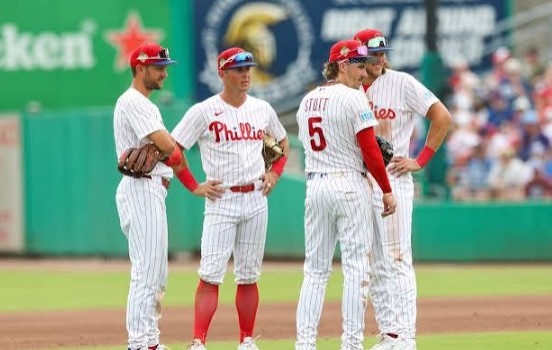
Arraez’s arrival forced Philadelphia into a defensive reshuffling. Harper moved back to right field, Bohm shifted to first base, and Stott moved to third. Stott has handled the position well, and the overall defense has looked more stable recently.
Still, the comparison with Atlanta remains difficult to ignore.
The Braves rank among baseball’s elite defensive teams and receive positive contributions from nearly every position. Their outfield, led by Michael Harris II, consistently turns difficult plays into outs. Philadelphia, meanwhile, has often required its pitchers to record extra outs because of defensive mistakes.
That difference helps explain why two teams with nearly identical offensive production have such different run differentials. In September, one missed ground ball or one dropped fly ball could determine the division race.
Braves matchup could decide the NL East
The Phillies will have seven remaining games against Atlanta, including a crucial four-game series in Philadelphia before traveling to Atlanta for three games from September 11–13.
So far, the Braves have dominated the season series, winning five of six games while outscoring Philadelphia 32–16. Since head-to-head record is MLB’s first postseason tiebreaker, the Phillies need to win at least six of the final seven meetings to secure that advantage.
If Atlanta takes two more games from Philadelphia, the Braves will own the tiebreaker, forcing the Phillies to finish ahead of them outright.
The remaining schedule leaves little margin for error. If Atlanta finishes 12–11 over its final 23 games, Philadelphia would need to go 15–8 just to force a tie and 16–7 to pass the Braves if Atlanta holds the tiebreaker.
The Phillies have shown they are capable of that kind of run. Their offense is dangerous, their rotation can dominate, and their recent form has proven the division race is far from over.
But Atlanta remains ahead because it is a more complete team.
Philadelphia can match the Braves offensively. Its top starters can compete with anyone in baseball. The biggest question is whether the Phillies can consistently make the routine plays when the pressure increases.
If the defense improves, Harper stays hot, and the pitching continues its dominance, the Phillies have a legitimate chance to steal the NL East. But if their defensive problems resurface against Atlanta, a remarkable September comeback could fall just short of first place.