The New York Rangers are reportedly on the verge of hiring forme veteran as their next head coach, according to ESPN’s Emily Kaplan. The sides are said to be in “advanced talks,” with Sullivan poised to become the 38th head coach in franchise history.
This move comes as little surprise. Rangers GM Chris Drury has long admired top veteran, a two-time Stanley Cup champion with Pittsburgh. Drury previously attempted to lure him in both 2021 and 2023, but the veteran coach remained with the Penguins each time. Now that Sullivan and Pittsburgh have officially parted ways after a decade together, he’s become the clear frontrunner to take over in New York following Peter Laviolette’s dismissal.
Sullivan is already one of the highest-paid coaches in hockey—reportedly earning over $5 million per year thanks to a 2023 extension—but Kaplan reports that his new deal with the Rangers is expected to surpass that figure, potentially making it one of the most lucrative coaching contracts in NHL history.
While other NHL teams—including the Penguins themselves—have vacancies, league insiders have consistently predicted a Sullivan-Rangers reunion. Sullivan previously served as an assistant coach in New York under John Tortorella from 2009 to 2013, a stint that helped solidify his standing in the league.
Would you like a breakdown of what Sullivan could bring to the Rangers’ current roster?
Elliotte Friedman summed up the prevailing sentiment around the league on Monday: “Until someone beats the Rangers out for Sullivan’s services, that’s who I’m picking … He’s their No. 1.” Fellow insider Frank Seravalli echoed that on the Daily Cuppa Hockey podcast, predicting: “The Rangers will have their coach by the end of this week,” strongly implying that Mike Sullivan is the choice.
The 57-year-old Sullivan boasts an impressive résumé. He led the Pittsburgh Penguins to back-to-back Stanley Cup titles in 2016 and 2017—his first two seasons behind their bench. In a decade with the Penguins, he amassed a franchise-best 409 wins (409-255-89), becoming just the 14th coach in NHL history to win 400 games with a single team. Overall, Sullivan’s 479 career coaching wins place him 32nd all-time in league history.
He also previously coached the Boston Bruins from 2003 to 2006 and has deep ties to the Rangers organization, having served as an assistant under John Tortorella from 2009–2013. All signs point to a high-profile homecoming in New York—one that could become official within days.
Would you like insight into how Sullivan’s coaching style could impact the Rangers’ systems or young core players?
Rangers could reunite with former coach John Tortorella in different role
In a surprising and compelling development, reports from ESPN’s Emily Kaplan and NHL Network’s Kevin Weekes indicate that John Tortorella could return to the Rangers as an assistant coach under Mike Sullivan—a notable role reversal for the two veteran bench bosses.
Tortorella, who famously served as Rangers head coach from 2009 to 2013, was Sullivan’s assistant earlier this year when the duo led Team USA at the 4 Nations Face-Off in February. That partnership may now continue in the NHL, this time with Sullivan as the lead and Tortorella in a supporting role behind the Blueshirts bench.
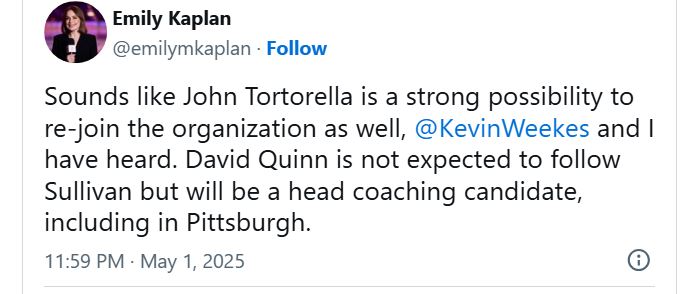
Kaplan hinted at the move on X, writing: “Sounds like John Tortorella is a strong possibility to re-join the organization as well.”
The idea of two fiery, defensive-minded coaches teaming up again—this time on Broadway—raises plenty of eyebrows but also offers intriguing potential for a team looking to toughen its identity and make a serious playoff run.
Would you be interested in a comparison of how Sullivan and Tortorella’s systems might complement (or clash with) each other?
John Tortorella, who was dismissed by the Philadelphia Flyers on March 27, remains one of the most accomplished coaches in NHL history—and especially in the annals of Rangers lore. His 171 wins behind the Rangers bench rank fifth all-time in franchise history, and across five NHL teams, his 770 career victories place him ninth on the NHL’s all-time wins list.
Among American-born coaches, Tortorella ranks second, trailing only Peter Laviolette (846), whom he may now indirectly replace in New York.
Given Tortorella’s history with the Rangers and his recent working relationship with Mike Sullivan at the 4 Nations Face-Off, a reunion in a supporting role is as plausible as it is fascinating—marking the first time such high-profile coaching figures would share an NHL bench in reversed roles.
Would you like a full coaching résumé comparison between Sullivan and Tortorella?
The potential reunion of Mike Sullivan and John Tortorella behind the Rangers bench would be a full-circle moment—both personally and professionally.
Back in the 2011–12 season, with Tortorella as head coach and Sullivan as his top assistant, the Rangers were among the league’s elite, winning 51 games and earning 109 points to capture the Atlantic Division title. That team came within two wins of a Stanley Cup Final appearance, falling in six games to the Devils in the Eastern Conference Final. The chemistry between Tortorella and Sullivan was a key part of that success.
Their coaching partnership actually dates back even further:
- Tampa Bay Lightning: Sullivan served as Tortorella’s assistant during their early-2000s run, helping lay the groundwork for the 2004 Stanley Cup.
- Vancouver Canucks: The duo reunited again in the mid-2010s.
If Tortorella does return, it would mark his third stint with the Rangers:
- Assistant coach under John Muckler in 1999–2000, finishing that season as interim head coach (0-3-1).
- Full-time head coach from 2009 to 2013, where he had his most success with the franchise.
- And now potentially returning in a surprising assistant role under Sullivan.
In a poetic twist, Rangers GM Chris Drury—the man making this decision—played for both Tortorella and Sullivan during the final two seasons of his NHL career (2009–2011). His trust in both men is undoubtedly informed by firsthand experience.
Would you like a deeper dive into how the Sullivan–Tortorella reunion could impact the Rangers’ locker room culture and systems?