With roughly two minutes left in the 2024 AFC Championship game, the Buffalo Bills were down by three points to the Kansas City Chiefs. Facing a crucial fourth down, they needed five yards to extend their drive—and keep their season alive.
Quarterback Josh Allen, who would go on to be named NFL MVP, dropped back and threw a pass over the middle to his only open receiver—second-year tight end Dalton Kincaid, the Bills’ 2023 first-round pick. The throw was slightly low but accurate, landing directly in Kincaid’s hands.
And he dropped it.
Just like that, the Bills’ season came to an end, along with what seemed to be a golden chance for the franchise to make its first Super Bowl appearance since 1993.
Allen Blames Self For Lack of Connection With Kincaid
Kincaid was devastated by the dropped pass, but his teammates, especially Allen, stood up for him. The three-time Pro Bowler took responsibility for the missed connection.
“He can replay that moment in his head all he wants, but I need to step up for him,” Allen told ESPN. “It comes down to me getting him more involved.”
Allen’s point was valid. Statistics reveal that Allen and the 25-year-old Utah tight end were often out of sync throughout the season—a problem the Bills need to address in 2025 as Kincaid enters the third year of his four-year, \$13.4 million rookie deal.
“I don’t think I put him in enough good spots this year, especially in terms of ball placement,” Allen added.
The seven-year veteran, who was also a first-round pick for the Bills (seventh overall in 2018), was right.
“Based on Fantasy Points data, only 69 percent of Kincaid’s 81 targets were considered catchable,” reported Sal Maiorana of the Rochester Democrat and Chronicle. “And on Allen’s throws traveling 10 or more yards downfield, just 37 percent were catchable. That’s harsh, plain and simple. For some reason, Allen and Kincaid just couldn’t sync up.”
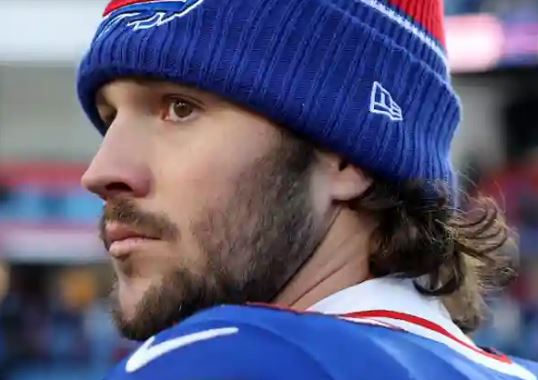
QB and Receiver Must Make Adjustments in 2025
NFL analyst Joe Marino from the Locked on Bills podcast noted that the rate of uncatchable passes between Allen and Kincaid was the highest in the league.
So, what can the Bills do about it? Marino suggests the issue might come down to adjustments that weren’t made in 2024 but need to happen in 2025.
“You’re still building chemistry with many players, and maybe it was assumed Kincaid was already established, but he’s still young and needed to develop alongside Allen,” Marino said on the Thursday Locked On podcast. “Plus, the significant turnover at skill positions didn’t help.”
Marino also highlighted that Kincaid was drafted under offensive coordinator Ken Dorsey, who was fired 10 games into Kincaid’s rookie season when the team was 5-5 and struggling offensively due to turnovers.
Joe Brady, the quarterbacks coach, was promoted to offensive coordinator and remained in that role through 2024.
“There’s definitely something to be said for that — an acclimation and adjustment period for everyone,” Marino added.
Since Brady continues as offensive coordinator into 2025, this adjustment process should improve.
“Allen was spot on with his assessment of his connection with Kincaid,” Maiorana wrote after the Bills’ surprising AFC Championship loss. “Their chemistry was lacking, both players share responsibility, and it’s an issue that must be addressed for the 2025 season.”