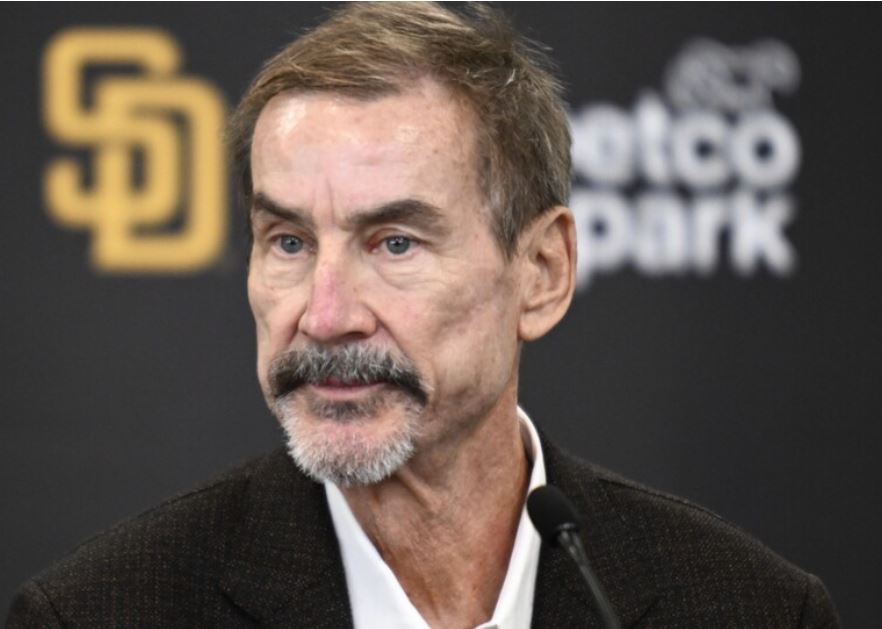
The San Diego Padres could be sold by the Seidler family.
After former chairman Peter Seidler passed away on Friday two years ago, selling the club first became a possibility. When Sheel, Seidler’s widow, filed a lawsuit in January to take over the team, those odds probably went up. In her court filing, she attempted to overturn any decisions made by the trust that owns 24% of the Padres, including the trust’s designation of John, Seidler’s brother, as the club’s manager. No new court filings have been made since late May in this ongoing lawsuit.

John Seidler made the announcement on Thursday that the family was starting “a process of evaluating our future with the Padres, including the potential sale of the franchise.”
Before the 2025 season began, Forbes valued the Padres at $1.95 billion. In contrast, recent MLB club sales have been finalized at roughly 5½ times a team’s yearly income. The Padres’ yearly revenue was estimated by one source to be $500 million, suggesting that the overall worth may approach $2.75 billion.
There are many questions raised by the possible end of an era.
Who among the group of owners wants to look into a sale first? Are the others wealthy enough to buy that individual out?
How intent on selling are the Seidlers?
And who could possibly buy the Padres?
Starts and stops
The “evaluation” of the Seidlers may be the beginning of a difficult journey.
The trail may not lead anywhere, if recent history is any guide.
Before declaring in August that the Minnesota Twins were no longer for sale, the Pohlad family looked at a number of options over a ten-month period. The Pohlads attracted new investors after prospective purchasers failed to match the family’s stated asking price of $1.7 billion.

Similarly, the Lerner family decided to keep the Washington Nationals in February 2024 after they had been up for sale for almost two years. After five months on the market, Los Angeles Angels owner Arte Moreno changed his mind and elected to keep the team in January 2023.
Since a group led by the heirs of former Los Angeles Dodgers owner Walter O’Malley purchased the Padres in 2012 for $800 million, which included the assumption of nearly $200 million in debt and an additional $200 million from the recently signed $1.2 billion cable deal, five Major League Baseball teams have been sold.
Prior to a nearly $8 billion agreement with Time Warner Cable, the Dodgers were sold to the Guggenheim group in 2012 for $2.15 billion.
In 2020, Steve Cohen paid an additional $2.4 billion for the New York Mets.
Top bucks is being paid to even small-market teams.
In 2017, a consortium led by Bruce Sherman and Derek Jeter purchased the Miami Marlins for $1.2 billion, and in 2019, a group led by John Sherman purchased the Kansas City Royals for $1 billion. Last year, David Rubenstein paid $1.725 billion to acquire the Baltimore Orioles, and in late September, a company led by Patrick Zalupski paid $1.7 billion to acquire the Tampa Bay Rays.
‘You evaluate everything’
The assumption of roughly $300 million in debt and over $150 million in paybacks to minority owners for two recent cash infusions, along with all the selling points that come with the Padres’ position in Southern California and Major League Baseball, will be included in whatever the Padres decide to sell for this time.
Marc M. Stern, a partner at Greenberg Glusker who was closely involved in the Donald Sterling trust dispute that resulted in the Los Angeles Clippers’ 2014 sale, stated, “You evaluate everything.” “Where can I make more money, what can I improve, and where is the operation already at its peak?”
The Padres’ debt doesn’t worry either Stern or Corey Martin, a managing partner and chair of Granderson Des Rochers’ entertainment finance practice. According to Martin, the remaining debts owed to Xander Bogaerts ($200 million), Fernando Tatis Jr. ($286 million), and Manny Machado ($301 million) could be considered the “cost of doing business,” though the specifics will depend on the team’s other obligations and sources of income in relation to the upcoming collective bargaining agreement.
In the meanwhile, a number of uncertainties, such as the possibility of a work stoppage when the CBA expires after 2026 and MLB’s intentions to consolidate all 30 teams’ local TV rights into a digital rights package by 2028, are short-term factors for what is thought of as a long-term investment.
Martin, whose firm advised rapper J. Cole joining a group that bought a controlling ownership in the Charlotte Hornets from Michael Jordan in 2023, stated, “It’s an enterprise value play.” “Obviously, you’ll look for ways to take money out of the business, but most people are looking at opportunities where the internal rate of return will be measured against what the business sells for down the road.”
Under Seidler’s leadership, the Padres’ worth has already more than doubled. It’s also difficult to find a better run of success in club history on the field.
The Padres have made it to the postseason four times in the last six years and in consecutive seasons. They are among the top 10 in baseball for non-media local revenue and have broken team attendance records three times in a row. The Padres have a global presence thanks to their investments in players from Japan, South Korea, Taiwan, and other nations, as well as San Diego’s close proximity to Mexico.
Stern stated that even if it could be as keyless as it gets, “you still need to put money in (the club) to perpetuate it.”
Who could accomplish it is the question at hand.
Finding the right fit
The Seidler family’s financial advisor, BTD & MSD Partners, can begin by examining who has lost previous attempts to purchase other MLB teams.

Before the Lerners chose to retain the Nationals, Ted Leonsis, the owner of the Washington-based Wizards, Capitals, and Mystics, offered more over $2 billion. Before the Twins were taken off the market, billionaire owners of the Phoenix Suns and Mercury, Mat and Justin Ishbia, were prospective bidders. Since then, White Sox owner Jerry Reinsdorf and Justin Ishbia have reached an agreement on a long-term investment structure. Before Moreno changed his mind, there were rumors that Los Angeles Times owner Patrick Soon-Shiong and Golden State Warriors main owner Joe Lacob were interested in the Angels. Lacob attended UC Irvine and Katella High School in Anaheim while working as a peanut vendor at Angel Stadium.
One of San Diego’s billionaires, Joe Tsai, the owner of the Brooklyn Nets, owns multiple sports teams, including the San Diego Seals lacrosse team, and resides in La Jolla. He denied having any known investment in an MLB franchise and denied being involved in the Mets’ 2020 transaction.
Despite his previous attempts to purchase the Chicago Cubs (2007), Texas Rangers (2010), and Los Angeles Dodgers (2011), former Dallas Mavericks majority owner Mark Cuban does not. Since then, the 67-year-old TV personality and businessman has transferred his sporting interests to Harbinger sporting Partners, a private equity firm seeking to distribute $750 million among five to fifteen properties, each with a maximum 5% share.
Hedge funds and private equity groups that have expressed interest in teams include Ares Management and Arctos Sports Partners. Among its six MLB interests, Arctos now has a small ownership in the Padres.
Why buy?
Simple supply-and-demand economics explains why team ownership is becoming more and more popular.
Martin compared it to oceanfront real estate. There are only so many homes directly on the beach in any well-known neighborhood. They are a trophy asset because of this. There are just so many available.
The Padres are now available for purchase.