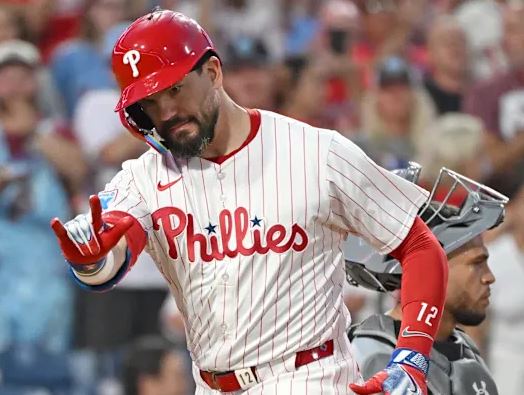
When the Phillies confirmed they were bringing back star designated hitter Kyle Schwarber, it likely struck a nerve with Atlanta Braves fans. Schwarber has been a major factor in Philadelphia’s success over the past four seasons and has consistently tormented Atlanta in the process.

Since joining the Phillies in 2022, no player has hit more home runs against the Braves than Schwarber. Even if his four-homer outburst against Atlanta last season were removed, he would still sit tied at the top of that list.
While keeping Schwarber is clearly a short-term headache for the Braves, the financial commitment Philadelphia made to retain him could end up helping their rivals in the long run.
There is no denying that re-signing Schwarber gives a significant boost to a Phillies team chasing a third consecutive NL East title. Over the past four seasons, only 19 hitters in baseball have posted a better wRC+ than Schwarber, and since 2022, the only player with more home runs is Aaron Judge.
Simply put, Schwarber is one of the most dangerous hitters in the sport, and there may be only one DH who can clearly claim to be better. Still, committing to a player who will turn 33 soon and paying him $30 million per season through his age-37 year comes with obvious risk.

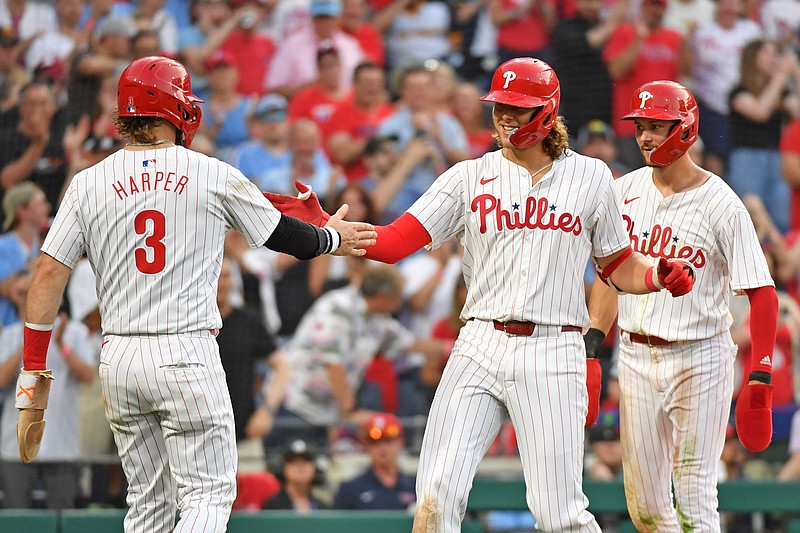
With Schwarber’s new deal on the books, the Phillies are already guaranteed to owe at least $105.4 million to four players in 2030. Schwarber, Trea Turner, Aaron Nola, and Bryce Harper will all be 37 that season. If Cristopher Sánchez’s team option is exercised, it would add another $16 million, though he would still be four years younger than the others.
History suggests this is a dangerous age range. Since 2010, position players aged 37 or older have produced only 11 seasons of at least 3.0 bWAR and just 31 seasons of 2.0 bWAR or more. Pitchers in that age group have fared only slightly better.
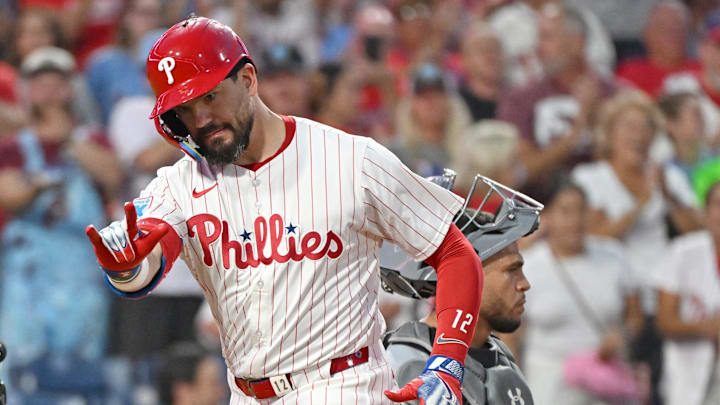
The aging curve is unforgiving in the mid to late 30s. While Harper, Schwarber, and Turner were excellent last year, Nola’s contract is already raising concerns after he showed signs of decline in both performance and durability for the first time in his career.
Philadelphia understands these risks but is clearly prioritizing a championship window. If they fail to win it all in the coming years, however, these contracts could become a major advantage for division rivals like the Braves and Mets, with so much payroll tied to aging stars.
Even before this offseason, the Phillies already had $168 million committed to seven players, and some long-term deals, including Nick Castellanos’s, have not aged well. For Schwarber, whose value is almost entirely dependent on his bat, sustained production is essential. If he experiences a drop-off similar to what Marcell Ozuna showed between ages 33 and 34, this contract could quickly turn into a serious problem.