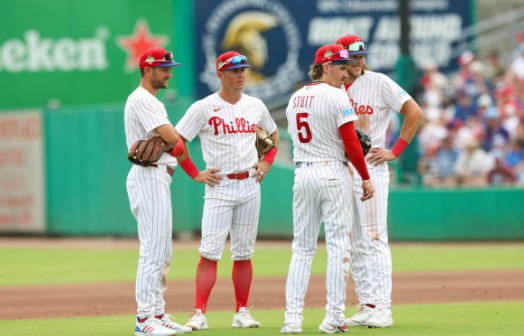
While much of the baseball world was focused on the excitement of All-Star Week in Philadelphia, the Phillies quietly continued building for the future.
Away from the spotlight of the Home Run Derby and Midsummer Classic, Philadelphia made a low-profile move that could eventually pay significant dividends by signing former Texas Longhorn left-handed pitcher as an undrafted free agent. The signing may not have generated national headlines, but it represents another calculated investment in pitching depth by a Phillies organization that has consistently prioritized developing homegrown arms.

The Phillies have earned a reputation for uncovering overlooked talent in recent years, and Higgins now becomes the latest player to receive an opportunity to prove he belongs in one of baseball’s most respected player-development systems.
For Higgins, signing with Philadelphia marks the beginning of a new chapter after an impressive collegiate career that showcased resilience as much as raw talent. The former Texas Longhorn spent years competing against some of the nation’s best hitters, developing the poise and command necessary to succeed in high-pressure environments.
Although he went unselected during the 2026 MLB Draft, many evaluators believed the left-hander possessed enough upside to earn a professional opportunity shortly afterward. The Phillies clearly agreed.
Philadelphia’s front office has repeatedly demonstrated that the draft is only one avenue for acquiring talent. Every year, organizations find future contributors among the undrafted free-agent class, and the Phillies have made it a priority to aggressively pursue pitchers they believe can flourish under their development staff.
That philosophy has become increasingly important as the club balances competing for championships at the major league level while replenishing its farm system.
The timing of Higgins’ signing is no coincidence.
During the All-Star break, front offices around baseball often turn their attention from the major league spotlight toward organizational depth. With scouts completing months of evaluations and draft meetings finally behind them, clubs immediately begin recruiting undrafted players they believe can outperform their draft status.

Philadelphia wasted little time making its move.
The Phillies’ pitching pipeline has become one of the organization’s greatest strengths over the past several seasons. Prospects like Andrew Painter have highlighted the system’s ability to develop frontline starters, while several homegrown relievers have also emerged through the minor leagues.
Adding Higgins gives the organization another developmental project with the potential to climb the ladder if he can continue refining his arsenal.
The move also comes at a time when pitching depth has become more valuable than ever.
Injuries have once again reminded clubs how quickly rotations and bullpens can be tested over a 162-game season. The Phillies recently suffered a major setback when reliever Brad Keller was ruled out for the remainder of the season with a torn UCL, creating another reminder of just how fragile pitching staffs can be over the course of a long campaign.
Building organizational depth has therefore become just as important as acquiring star power.
For Higgins, the opportunity couldn’t come with a better organization.
Philadelphia entered the second half of the season firmly in the postseason picture behind one of the National League’s strongest pitching staffs. Cristopher Sánchez continued his breakout campaign by earning the honor of starting the 2026 MLB All-Star Game, becoming the first Phillies pitcher to receive that distinction since Roy Halladay in 2011. Zack Wheeler has continued to perform like one of baseball’s elite veterans, while the club has consistently leaned on pitching to remain among the National League contenders.

Learning within that environment gives young pitchers valuable examples of how successful major league arms prepare, compete, and adjust throughout a season.
Higgins will likely begin his professional career in the lower levels of the Phillies’ minor league system, where the organization’s pitching coordinators will focus on sharpening his command, refining his secondary offerings, and helping him adjust to professional hitters.
While the road to Citizens Bank Park remains a long one, history has shown that undrafted players can make meaningful impacts at the highest level. Every season, overlooked prospects emerge from obscurity to become valuable contributors, and organizations willing to invest in development often reap the rewards years later.
Philadelphia’s scouting department has built a reputation for looking beyond draft position, instead emphasizing projection, coachability, and long-term upside.
Those qualities appear to have convinced the Phillies that Higgins was worth adding to the organization.
As the major league club continues its pursuit of another postseason berth, the front office remains equally committed to strengthening the future. Quiet signings during the All-Star break rarely dominate headlines, but they often become important pieces of an organization’s long-term success.
Whether Higgins eventually reaches Citizens Bank Park remains to be seen. However, his signing reflects the Phillies’ continued commitment to finding talent wherever it can be found—a philosophy that has helped keep both the major league roster and the farm system stocked with promising pitching.
For now, one of the biggest stories from Philadelphia’s All-Star break wasn’t made under the bright lights of the Midsummer Classic. It came quietly, with a former Texas Longhorn receiving the opportunity every undrafted player dreams of: a chance to begin a professional career with a World Series contender that has proven it knows how to develop pitchers.