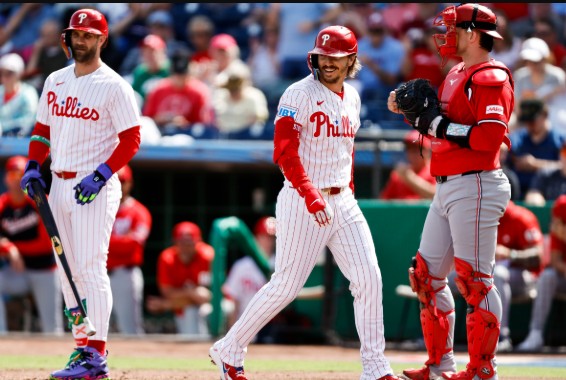
The Philadelphia Phillies entered the second half of the season fully aware that reinforcing the bullpen would be one of their top priorities before the MLB trade deadline.
Adding a left-handed reliever was already high on the club’s wish list, but Brad Keller’s season-ending UCL injury has significantly changed the equation. Instead of searching for just one bullpen upgrade, president of baseball operations Dave Dombrowski may now need to acquire multiple relievers to stabilize the relief corps for the stretch run.
Until the front office makes a move, however, the responsibility falls on the pitchers already in the clubhouse. Several arms will be asked to take on expanded roles as the Phillies try to remain in the National League playoff race without one of their most dependable relievers.
José Alvarado
Few Phillies pitchers have more to prove over the final months of the season than veteran left-hander José Alvarado.
The hard-throwing southpaw endured an inconsistent first half, posting a 6.82 ERA over 39 appearances and 33 innings. Those numbers fall well short of the impact Philadelphia expected from one of its most experienced late-inning relievers.
With Keller no longer available to bridge the gap to closer Jhoan Durán, Alvarado has an opportunity to reclaim a prominent role. Despite his struggles this season, he has repeatedly shown throughout his career that he can thrive in pressure-packed situations. If he rediscovers that form, the Phillies’ bullpen could receive a much-needed boost without making an external addition.
Seth Johnson
Seth Johnson’s season has been a tale of two levels.
The right-hander has bounced between Triple-A Lehigh Valley and Philadelphia throughout the year and returned to the major league roster after Keller landed on the injured list. His big-league numbers have been rough, as he owns a 7.15 ERA across 11.1 innings in 11 appearances.
His performance in Triple-A tells a much different story. Johnson dominated opposing hitters with a sparkling 2.17 ERA over 29 innings, displaying the command and swing-and-miss stuff that convinced the Phillies to keep giving him opportunities.

If he can translate that success to the majors, Johnson could emerge as one of the bullpen’s most valuable contributors during the second half.
Aaron Nola
Aaron Nola won’t be making the transition to the bullpen, but Keller’s injury places additional importance on every one of his starts.
Philadelphia plans to keep the veteran right-hander in the No. 4 spot of the rotation, especially with limited starting pitching depth behind its top three arms. However, the bullpen will be under greater strain, making it critical for Nola—and whoever occupies the fifth starter’s role, whether it’s Alan Rangel or another option—to consistently pitch deeper into games.
Every extra inning covered by the starting rotation reduces the workload on an already thin relief corps. Nola offered an encouraging glimpse of what’s needed by working into the seventh inning in his first outing after the All-Star break against the New York Mets.
If he can continue delivering quality length, it could have a significant impact on the bullpen’s effectiveness over the remainder of the season.
Jonathan Bowlan
Jonathan Bowlan has quietly become one of Philadelphia’s biggest bullpen success stories.
Acquired from the Kansas City Royals during the offseason as part of the Matt Strahm trade, Bowlan has exceeded expectations in his first season with the Phillies. He compiled a 2.93 ERA over 33 appearances and 30.2 innings during the first half while striking out 38 batters, establishing himself as one of the club’s most reliable relievers.
With Keller sidelined, Bowlan appears poised to inherit a larger share of the high-leverage workload. He could become the primary right-handed setup option behind Orion Kerkering, helping bridge games to closer Jhoan Durán.
If Bowlan continues pitching at the level he displayed before the All-Star break, the Phillies may already have one of the internal solutions they need as they navigate the second half of the season.