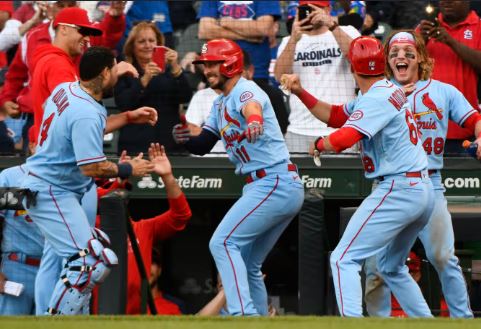
The St. Louis Cardinals approached Monday’s trade deadline with a strategy that appeared to balance the present and the future, but one move ultimately stood out for all the wrong reasons. The club dealt away two pitchers headed for free agency, shipped a controllable outfielder in exchange for prospects, and then turned around to acquire a veteran reliever who is also set to become a free agent after the season.
That final transaction raised the biggest questions.
The Cardinals acquired left-handed reliever Caleb Ferguson from the Cincinnati Reds in exchange for international bonus-pool money. While the price was modest and Ferguson has the experience to help a bullpen in need of depth, the move seemed inconsistent with the organization’s broader deadline approach. For a team sitting below .500 and caught between competing now and building for the future, using a valuable future asset on a short-term rental felt like an unnecessary compromise.
To their credit, St. Louis accurately assessed its position in the standings. Even after Alec Burleson’s remarkable performance against the New York Yankees—belting three two-run home runs in a 13-7 victory—the Cardinals remained fourth in the National League Central, 13.5 games behind the division-leading Milwaukee Brewers. They also sat four games back of the final National League Wild Card spot, with multiple teams standing in their way.
While those circumstances leave the door slightly open for meaningful baseball, they hardly justify sacrificing future resources for a marginal improvement.
Ferguson Doesn’t Fully Fit the Timeline
Ferguson, 30, entered St. Louis after posting a 4.01 ERA over 26 appearances, including one start, with Cincinnati. Signed to a one-year, $4.5 million contract last offseason, he is expected to hit free agency once the campaign concludes. Reports indicated the Cardinals gave up $250,000 in international bonus-pool money to complete the trade.
Although the Cardinals avoided parting with a prospect, international signing money remains a valuable organizational asset. It can be used to pursue amateur talent, create flexibility during signing periods, or facilitate additional trades. Those options seem more valuable for a franchise focused on rebuilding its pitching depth and strengthening its long-term outlook.
The Rest of the Deadline Told a Different Story
Elsewhere, Chaim Bloom’s deadline decisions reflected that long-term philosophy. St. Louis traded impending free agents Dustin May and JoJo Romero to Milwaukee in exchange for outfield prospects Alexander Frias and Josiah Ragsdale. The club also sent Lars Nootbaar to the Arizona Diamondbacks, receiving pitching prospects Daniel Eagen and Sandro Santana, along with a player to be named later.
Those trades prioritized future control and organizational depth. The Ferguson acquisition, however, moved in the opposite direction.
Supporters of the move could argue that a club only four games out of a Wild Card berth shouldn’t completely wave the white flag. By acquiring an experienced left-handed reliever without giving up a prospect, the Cardinals added bullpen depth after moving May and Romero while allowing manager Oli Marmol another reliable major league arm. Compared to the uncertainty of international signing money, Ferguson provides immediate value.
It’s a reasonable perspective—but one that may overlook the bigger picture.
An Uncomfortable Middle Ground
Relievers are among baseball’s most unpredictable assets, and Ferguson isn’t viewed as a dominant late-inning difference-maker capable of dramatically changing St. Louis’ postseason chances. At the same time, the Cardinals weakened both their rotation and bullpen by trading away May and Romero.
If the front office believed the team was positioned to buy, it arguably needed to acquire players with either greater impact or multiple years of control. If it believed selling was the correct course, preserving every future asset would have made more sense.
Instead, the Ferguson trade landed somewhere in between—offering neither a significant boost to the 2026 roster nor meaningful long-term value.
Nootbaar Trade Carries Stronger Logic
The decision to trade Lars Nootbaar also sparked debate, especially after his offensive numbers dipped following surgery on both heels. After returning in June, he hit .234 with a .688 OPS across 48 games. Still, he remained under team control through the 2027 season.
Even so, the return appears easier to justify. Daniel Eagen, ranked fifth in Arizona’s farm system before the trade, recorded 109 strikeouts in 87⅓ Double-A innings despite posting a 4.95 ERA. Sandro Santana and the player to be named later further strengthen the package, giving the Cardinals multiple pitching pieces that could contribute in future seasons.
Unlike the Ferguson acquisition, the Nootbaar deal clearly aligned with a strategy centered on acquiring controllable young talent.
Staying True to the Long-Term Vision
Calling the Ferguson trade a major mistake would likely be an overreaction. The acquisition cost was relatively small, and the veteran left-hander could still provide valuable innings down the stretch.
However, among all of the Cardinals’ deadline moves, it was the one that seemed least consistent with the organization’s stated direction.
As Chaim Bloom continues reshaping the franchise following the departures of veteran stars like Nolan Arenado and Sonny Gray, maintaining a disciplined long-term approach will be critical. Every move should contribute toward building the next sustainable contender.
Ferguson may help St. Louis win a few games over the final two months of the season. But unless those victories somehow fuel an unlikely postseason run, the Cardinals will have spent a future asset on a short-term addition despite the rest of their deadline strategy acknowledging that the club’s greatest opportunity lies beyond 2026.