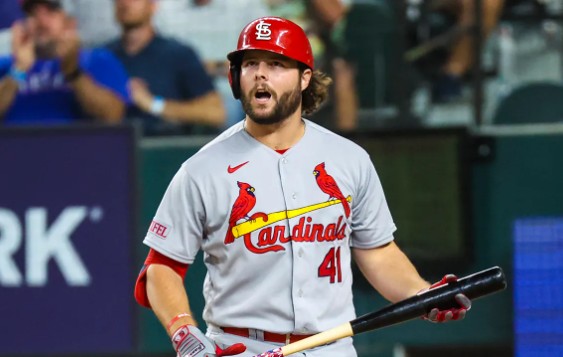
Perhaps Brad Pitt deserves some of the blame for the long-running belief that first base is an easy position, but a new Statcast metric is offering a clearer picture of the defensive demands involved — and Alec Burleson certainly approves.
“It just kind of gives you a better view, that first base isn’t that easy,” Burleson said. “It’s not as easy as people say it is.”
Inside the Cardinals’ clubhouse, Burleson’s defensive value at first base has long been accepted as fact, even when publicly available metrics failed to support that reputation.
The biggest reason the Cardinals have been so confident in his abilities, however, had not been captured by a meaningful public statistic.
Until now.
Late Tuesday night, Statcast unveiled a new metric called Receiving Outs Above Average, designed to measure an area of first-base defense that had previously been overlooked in publicly available data.
Burleson’s ability to receive throws.
On Statcast’s new First Base Receiving leaderboard, Burleson currently leads all of MLB with a plus-7 Receiving OAA.
That particular skill was not reflected in previous defensive statistics, and the numbers that were available did not paint Burleson in a favorable light.
He owns a minus-3 Outs Above Average, ranking 28th among 39 qualified first basemen. Statcast’s non-receiving Fielding Run Value numbers were similarly harsh, with Burleson tied for 67th out of 84 qualified first basemen.
But once the value of his receiving ability is included, Burleson climbs all the way to a tie for ninth on the overall Fielding Run Value leaderboard.
For Burleson, that result makes perfect sense. He believes catching throws is a major part of the responsibility that comes with playing first base.
“Ninety percent of my job is to catch the baseball,” Burleson said. “You get, basically, rated as a first baseman on the other 10%, which is just ground balls. … You don’t get the credit for picking baseballs or your footwork around the base. So, it’s good to be recognized for that, just to see where you stack up against the rest of the league.”
Cardinals manager Oliver Marmol has been one of Burleson’s biggest believers for a long time. Marmol recognized early on what the 2020 second-round pick out of East Carolina University could become if the organization remained patient and continued investing in his development.
“I’ve talked about Burly and what he brings for a very long time,” Marmol said. “And I remember his first year when some of the actuals didn’t match the underlying stuff that we were looking at. And it was all pointing in a very, very good direction. I’m glad we were convicted in continuing to give it time to become what it’s become.”
Burleson is already the reigning National League Silver Slugger Award winner as a utility player after splitting time between the outfield and first base last season, appearing in 74 games in the grass and 50 more at first.
During his first four MLB seasons, Burleson spent significant time in the outfield because the Cardinals needed to find a way to keep his bat in the lineup. He embraced the assignment and worked hard enough to become a capable option.
But the outfield was never where Burleson was meant to play.
An offseason trade involving Willson Contreras eventually opened the door for him to return to his natural position, and his defense at first base has flourished in 2026, regardless of whether the previous numbers showed it.
“He’s really good over there,” Marmol said. “You can create as many metrics as you’d like. They’ll all tell you he does a really nice job. Guys like throwing across the diamond to him.”
Rookie infielder Blaze Jordan has experienced that firsthand. After playing third base only sporadically with Triple-A Memphis earlier this season, Jordan has been adjusting to the challenges of the hot corner at the Major League level since his midseason promotion.
Knowing that Burleson is waiting at first base has helped make that transition easier.
“It’s nice to know, you just kind of throw it in the vicinity over there, he’s going to catch it,” Jordan said. “It makes our job a lot easier and it’s just really great to have him over there.”
Before the arrival of Receiving OAA, much of the recognition Burleson received for his defensive work came in a far less analytical form, though it still carried plenty of meaning: gratitude from his fellow infielders after he turned an errant throw into an out.
Now, those plays finally have a number attached to them.
“Before, it was thank-yous. Now, we have it on paper and the thank-you turns into an Out Above Average or whatever it is,” Burleson joked. “But yeah, it’s definitely cool. I don’t know how I can manipulate that stat to make it any better, but I’ll be trying to do that.”
Leave a Reply